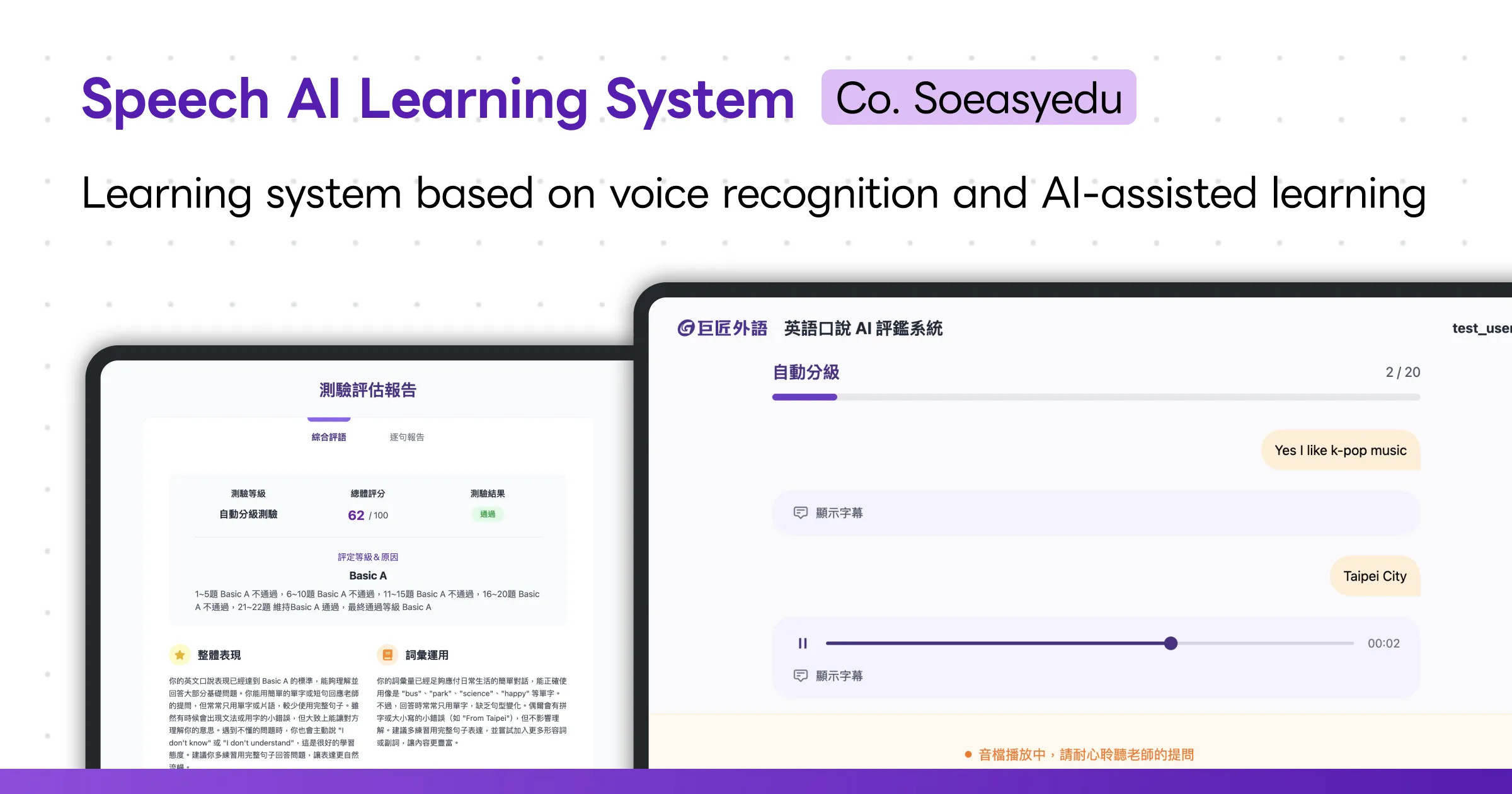
Project Overview
Developed in collaboration with Jujiang, this AI-driven multilingual learning platform supports scenario-based conversation and speaking practice in English, Japanese, Korean, and other languages. It combines OpenAI GPT for dialogue and content evaluation with Azure Speech Services for speech recognition and speaking analysis, then produces detailed learning reports.
The backend uses a fully async FastAPI architecture with a PostgreSQL database. The frontend is built with React 19 + Vite, deployed in containerized multi-environment configurations via Docker Compose.
Core Features
AI Real-Time Conversation Practice
A multilingual conversation engine powered by OpenAI GPT, supporting scenario-based and assessment modes with difficulty adjusted to the target language and learner level.Multilingual Speech Recognition and Speaking Assessment
Integrates Azure Speech Services for real-time speech-to-text, analyzing speaking performance for each language and providing detailed feedback on a 50-60-80-100 scale.Multilingual, Multi-Level Content
Organizes learning content by language, level, and scenario. Each level contains a structured conversation flow (ChatFlow) driven by JSON configuration.Learning Analytics Reports
Records scores, speaking feedback, and improvement trends for each session, giving learners and administrators cross-language learning analytics.Admin Dashboard
Administrators can manage learning records, create and edit learning levels, view assessment group data, and monitor system status through the admin panel.Technical Architecture
Frontend
Built onReact 19 with Vite, using React Router v7 for routing, Tailwind CSS for a custom-themed interface (purple primary + orange accent), and Axios for API communication.Backend
Uses the fully asyncFastAPI framework with SQLAlchemy 2.0 and the asyncpg driver for async database operations, Alembic for migration management, and Poetry for Python dependency management.AI and Speech Services
Conversation engine and content evaluation useOpenAI API (GPT + TTS). Speech recognition integrates Azure Cognitive Services Speech SDK. Audio processing uses SoundFile and PyDub for format conversion.Authentication and Security
JWT token authentication with bcrypt password hashing, supporting a dual-role system for administrators and regular users.Deployment
Docker Compose multi-environment deployment (Local / Dev / Prod) with Nginx reverse proxy, PostgreSQL database container, and PgWeb management interface.Database Design
Uses PostgreSQL with SQLAlchemy 2.0 (async), managing learning record lifecycles through a state-machine pattern — from creation, conversation, and completion through to scoring — fully tracking every learning session.
| Table | Description | Key Fields |
|---|---|---|
| users | Learner accounts (UUID-identified) | id, name, email |
| managers | Administrator accounts (password stored as hash) | id, username, password_hash |
API Design
RESTful API designed with FastAPI, fully async to support real-time voice conversation scenarios:
Conversation and Voice /api/records
Learning Levels /api/chat-levels
Evaluation System /api/evaluate
User Management /api/users / /api/managers
Utility Services /api/tools
Deployment Architecture
Multi-Environment Docker Compose Configuration
Supports three deployment environments — Local (direct connection), Development (Nginx + Hot Reload), and Production (Nginx reverse proxy + optimized build) — all including a PostgreSQL database container and PgWeb database management interface.Service Components
Frontend (React SPA), Backend (FastAPI + Uvicorn), PostgreSQL 15, Nginx reverse proxy, PgWeb database management, shared audio file volume.