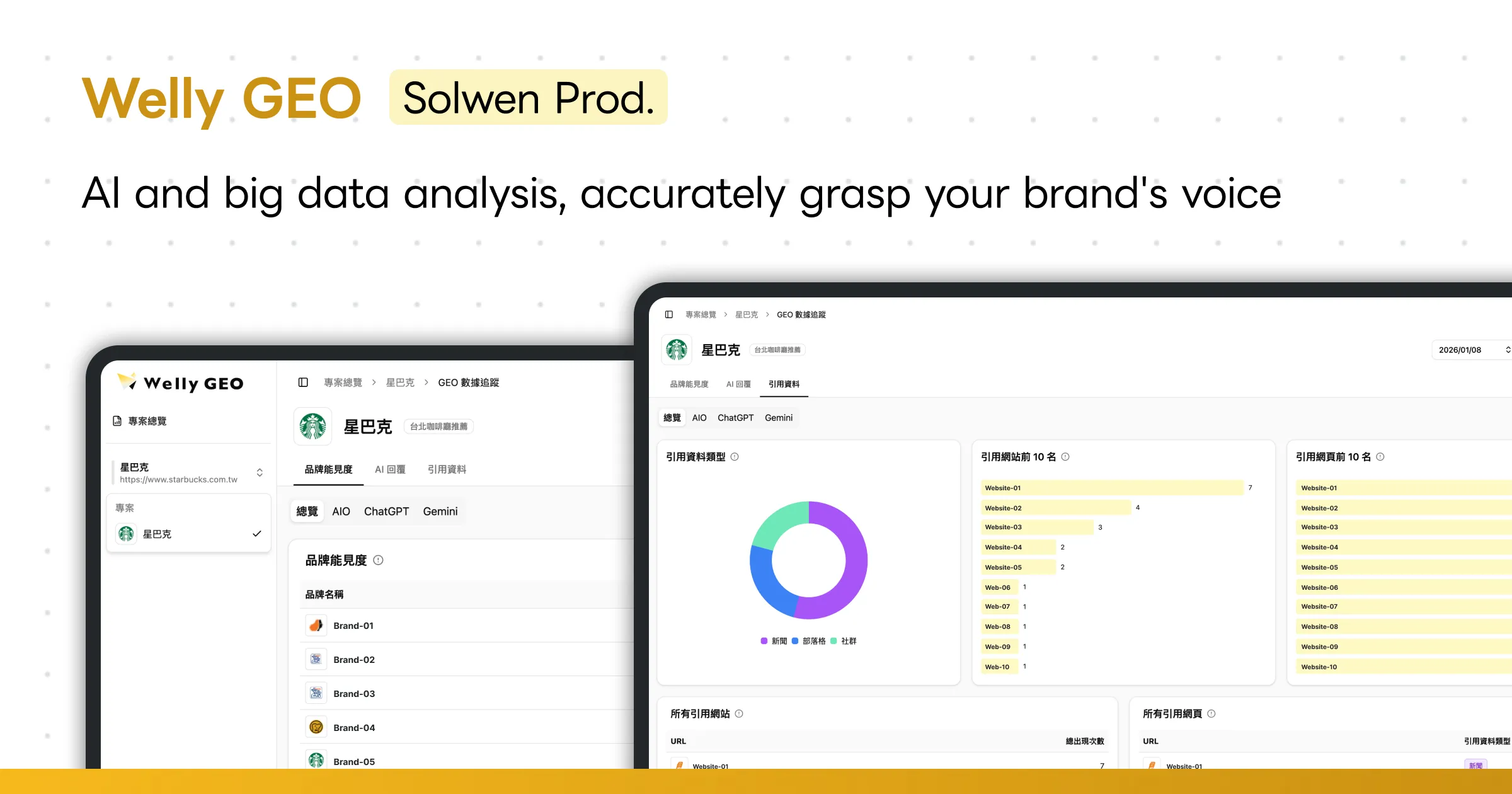
Project Overview
WellyGeo is an AI Brand Visibility Tracking Platform (GEO, Generative Engine Optimization) developed by Solwen AI, helping brands monitor their exposure performance in AI search engines.
The system automatically sends queries to ChatGPT, Google Gemini, and Google AI Overview, captures AI response content and analyzes how frequently brands are mentioned, citation sources, and competitor comparisons. It produces visual trend reports to help marketing teams optimize their brand visibility strategy within the AI ecosystem.
System Architecture
WellyGeo consists of two major subsystems forming a complete data collection and analysis pipeline:
Frontend — Data Analytics Dashboard
An SPA application built withReact 19 + TypeScript + Vite, integrated with the shadcn/ui component library and Recharts chart visualization. Includes feature modules for project management, brand visibility trend charts, AI response analysis, citation source tracking, and competitor comparison, with i18next bilingual support for Traditional Chinese and English.Crawler — AI Response Crawling Engine
A crawler service built withPlaywright + Express.js that simulates user interactions through browser automation to capture responses from ChatGPT and Google Gemini. Google AI Overview data is obtained via SerpAPI. Crawled results are uploaded to AWS S3 in JSONL format, with support for large-scale distributed execution on AWS Batch/Fargate and Webhook callback notifications.Core Features
Brand Visibility Analysis
Tracks trends in how frequently a brand is mentioned across different AI platform responses, presenting visibility distribution through line charts, pie charts, and bar charts, along with detailed data tables.AI Response Content Analysis
Analyzes the context in which a brand appears in AI responses, sentiment orientation, and recommendation ranking, revealing how AI describes and recommends the brand.Citation Source Tracking
Analyzes the web sources and type distribution cited in AI responses, identifying which content AI uses as the basis for brand information.Competitor Comparison
Automatically detects or manually configures competitors to compare brand and competitor AI visibility differences across the same query dimensions.AI Keyword Generation
Integrates AI to automatically generate brand-related search topics and query phrases, with CSV batch import support to accelerate project setup.Multi-Platform Crawler Scheduling
Supports ChatGPT, Google Gemini, and Google AI Overview, with platform combinations selected to match each collection task.My Role & Contributions
Full Frontend Development
Independently responsible for the complete development of the Frontend dashboard, including project management workflows, brand visibility charts (line, pie, and bar charts), AI response analysis pages, citation source tracking, competitor comparison configuration, and i18next bilingual switching between Traditional Chinese and English.Crawler System Development Support
Participated in Crawler backend development, helping build Playwright browser automation crawlers, fixing Gemini error handling, and maintaining documentation and logging systems.Development Workflow Setup
Introduced Husky + lint-staged for automated pre-commit checks, configured ESLint + Prettier to enforce consistent code style, and established team development standards.Code Review
Responsible for reviewing team members’ Pull Requests to ensure code quality and architectural consistency.Technical Highlights
Cross-Platform Browser Automation
Built maintainable browser automation, error handling, and recovery flows for multiple AI platforms to keep long-running collection tasks stable.Authentication and Session Management
Organized sign-in, session persistence, and recovery behavior to reduce interruptions when authentication state expires during automated tasks.Infrastructure as Code
Used AWS CDK with TypeScript to manage container execution, storage, and access-control resources as reproducible infrastructure.CI/CD Automated Deployment
Connected frontend and container build, validation, and deployment workflows through GitHub Actions to reduce manual release steps and retain an auditable deployment history.